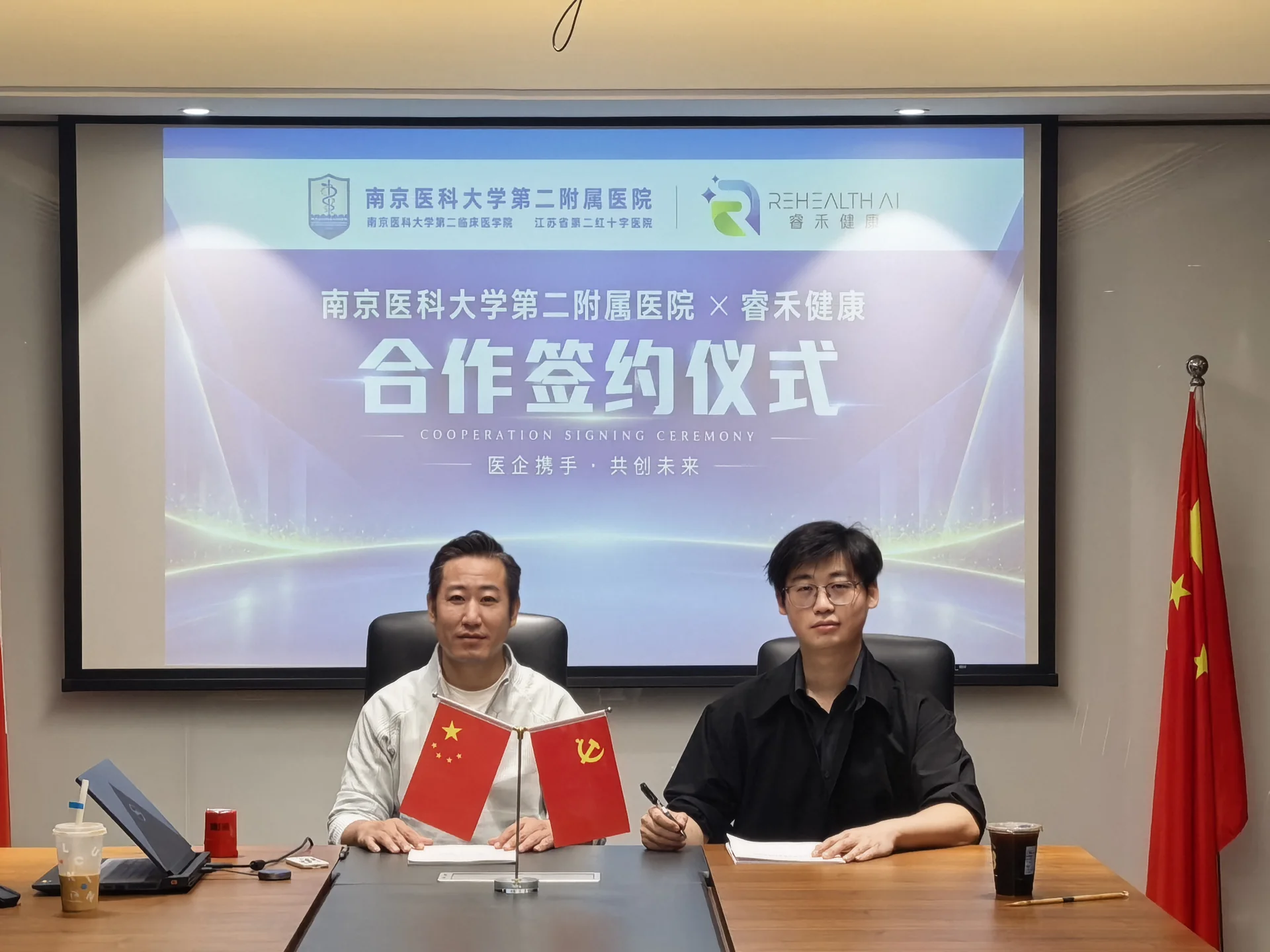
The Second Affiliated Hospital of Nanjing Medical University and ReHealth AI recently signed a joint research and technology-transfer agreement for a full-course intelligent management project in urology. Under a model centered on joint R&D and productization, with clinical research topics progressing in parallel, the parties will contribute specialty knowledge, clinical resources, data conditions, software technology and model capabilities. The work is planned to cover development, in-hospital deployment, pilot validation and technology transfer for a urology management model, supporting software, an intelligent follow-up agent and wearable-device data integration across initial assessment, care support, perioperative management, post-discharge recovery and long-term follow-up.
Joint development and responsibilities
The parties have established a joint project team with working groups for clinical matters, product and technology, data security, research ethics, and technology transfer. The hospital will provide approved clinical pathways, follow-up protocols, medical rules, specialty materials and clinician-review mechanisms, and organize ethics review, clinical pilots and application evaluation. ReHealth AI, a preventive medical settlement infrastructure company, will handle software architecture, model integration, specialty knowledge enhancement, workflow orchestration, data interfaces, device-data integration and product delivery, and support in-hospital deployment, training and operations. New project outcomes will be jointly owned, with intellectual property registered according to each party's actual contribution.
Moving Uro-LLM toward a product platform
A key focus is moving the hospital's Uro-LLM model from a clinical research environment toward a product platform. The hospital will provide the research foundation, specialty knowledge and real-world validation setting. ReHealth AI will use specialty adaptation, knowledge enhancement, service packaging and product integration to turn the research model into deployable, operable, maintainable and deliverable modules. This requires more than moving a research prototype to a company server: input-data standards, model invocation, knowledge updates, output interpretation, version management and security auditing must also be addressed. Outputs involving serious abnormalities, uncertainty or clinical decisions will enter a clinician-review process.
Ownership of Uro-LLM and other pre-existing hospital outcomes will remain as specified in the agreement, while ReHealth AI's existing platform and general-purpose technology remain with the company. The hospital will continue to participate in reviewing medical rules, model outputs and clinical applicability so that the model is used only in settings and under rules approved by the hospital.
Adding cardiovascular risk screening and coordinated follow-up
The project adds a cardiovascular risk screening and coordinated follow-up module for urology patients. It is intended for older perioperative patients, patients receiving cancer treatment that may affect cardiovascular risk, and patients with risk factors such as hypertension, coronary heart disease, heart failure, arrhythmia, diabetes or a history of stroke. Planned functions include baseline assessment, symptom follow-up, device-trend monitoring and risk stratification, with an alert, review, response and referral loop. In the initial phase, cerebrovascular-related functions are limited to collecting history, risk factors and acute neurological warning signs and referring patients as appropriate; the module will not make automated diagnoses and will not replace specialist diagnosis, prescribing, treatment changes or emergency care.
ReHealth AI's preventive medical settlement infrastructure
ReHealth AI develops infrastructure for preventive medical settlement. Its core platform, ReHealth Core, connects risk stratification, intervention records, outcome evaluation and auditable evidence through a Predict–Intervene–Attribute–Settle framework. The company has primarily entered through cardiovascular prevention. This project applies related risk identification, intervention documentation and evidence-generation methods to a urology workflow, using real hospital workflows to examine cross-condition adaptation and standardized delivery. The planned execution layer includes an administrative console, patient-facing access, an intelligent follow-up agent, model capabilities and device-data integration.
Validating the work in a real-world setting
The project is planned to draw on multidisciplinary expertise in urology and cardiovascular care and proceed through five phases: preparation, prototype, pilot, refinement and transfer preparation. The provisional timeline is twelve months. The system is planned for deployment on hospital servers. Pilot work will begin only after ethics review, hospital approval and data authorization are in place, with evaluation planned around follow-up efficiency, outcome identification and alert-loop performance. In principle, original clinical data will be processed in the hospital's controlled environment and will not be provided to third parties or transferred outside China without the hospital's written consent and required legal procedures.
Expected deliverables include a specialty model, specialty knowledge base, data standards, software, interface and deployment documentation, test reports and application-evaluation reports. The parties will jointly advance outcome registration and technology transfer. Under the current plan, estimated revenue at the technology-transfer stage is RMB 5 million. The parties aim to establish a clear collaboration model: the hospital contributes specialty models and medical capabilities developed through clinical research; the company productizes and delivers them through its infrastructure platform; the work is jointly validated and refined in the hospital; and further applications are pursued under the agreement.
The system is intended as a clinician-supervised tool for care support and health management. It does not replace a licensed physician's diagnosis, prescription, treatment adjustment, surgical decision or emergency response. Project functions, condition scope, pilot scale and schedule remain subject to the parties' contract, ethics review, hospital approvals and technical appendices.